
They told you an LLC would solve the estate issue on your Miami apartment
It is probably the most repeated advice among Colombians who buy real estate in the United States. Open an LLC, put the apartment in it, and the estate issue is solved.
It is said with confidence, sold cheaply and done in two weeks. The problem is what does not come up in the conversation.
First, how big the problem is
The United States charges a tax on the estate of anyone who leaves property in its territory. For a U.S. citizen there is a fifteen million dollar exemption, so the issue rarely comes up.
For a non-resident foreigner the exemption is sixty thousand dollars.
Above that, a schedule applies that starts at 18% and reaches 40% on everything over the first million. An apartment worth one and a half million dollars in your name leaves a bill close to five hundred and thirty thousand dollars before your family can touch anything.
That is the 40 people talk about. It is not on the gain or on income. It is on the value of what you left.
That is why the two solutions most often offered sound so good. They are worth a close look.
"The LLC solves it"
A single-member LLC is, for U.S. tax purposes, transparent. The tax authority does not see it as separate from you. It sees you.
That is where the problem starts. If the LLC is transparent, then what you own is not an interest in a company: it is the apartment itself, which is property located in the United States. You are back where you started.
The honest answer is that this is not settled. The rules that make the LLC transparent were written for income tax, and how far they extend to estate tax is still an open question. The uncomfortable part is that both possible answers end up in the same place. If the LLC is ignored, you own the property and you pay. If it is not ignored, what you own is an interest in a U.S. entity, which also counts as property located there, and you pay anyway.
The LLC is not useless. It is just not the estate shield you were sold. It is a bet on an unanswered question, made without telling you it was a bet.
"Then set up a revocable trust"
This is the second most common answer, and it confuses two things that have nothing to do with each other.
Probate and the tax are different things
Probate is a procedure. It is the process before a judge in the county where the property is located, whose only purpose is to decide who the new owner is and order the title to change names. It answers the question of whose name it ends up in. It costs a local lawyer and court fees, takes months, and leaves a public file anyone can look up.
The tax is a bill. It is a percentage of the value of what you left, owed to the U.S. tax authority. It answers a completely different question: how much it costs to pass that to the next generation.
They are independent. There can be probate without a tax bill, when what is there is small. And there can be a tax bill without probate, which is exactly the case of someone who set up a trust believing everything was solved.
What the trust does and does not do
The trust does solve something real, and it is not minor: the assets pass without going through a court. The family saves months, fees and publicity.
What it does not do is touch the tax. The reason is in the name. Revocable means that until the last day you could undo it, change beneficiaries or take the apartment out. If you kept that power, for tax purposes the property never stopped being yours, and it goes entirely into the taxable base the day you are gone.
And a practical detail usually completes the surprise. When a foreigner with U.S. assets dies, banks and brokerage firms release nothing until the IRS issues a certificate confirming the tax matter is closed. They do not do it as a formality: if they release the money before the tax is paid, they are liable. That certificate requires filing the corresponding return, and it usually takes between six months and more than a year.
So the trust gets you out of court, but not out of the IRS line. The assets stay frozen.
It is a distinction easily lost because in Spanish both things go by the same name. "La sucesión" is the process, and "la sucesión" is the tax. The trust deals with the first. The 40% is untouched.
So what
The idea that does change the result is moving where death happens, in legal terms.
People die. Companies do not.
If the owner of the U.S. LLC is not you but a company formed outside the United States, the day you are gone what is there does not change owner. The LLC still belongs to the same company, which still exists. What passes to your heirs are the shares of that foreign company, and for the U.S. tax authority that is property located abroad.
There is no U.S. property to pass. The tax is not triggered.
Two things worth saying clearly, because this is often sold badly.
It does not eliminate the estate process; it relocates it. There is still an estate to settle, where the person had their assets and residence. What is avoided is a 40% payment to the U.S. tax authority on what was there, on top of that. It is one less front, not zero fronts.
It has a cost. A structure like this makes the operation more expensive every year, changes how rental income is taxed and makes the exit more costly the day you want to sell. How much each item weighs depends on the amount, how you use the property and how long you plan to hold it. Solving the estate and breaking the sale is a fairly common result when a structure is built looking at a single tax. That is why it is not a recipe: it is a decision made with the numbers of the case on the table, and before signing the offer.
What has to be looked at anyway
Whatever the decision, these three remain and surprise many people.
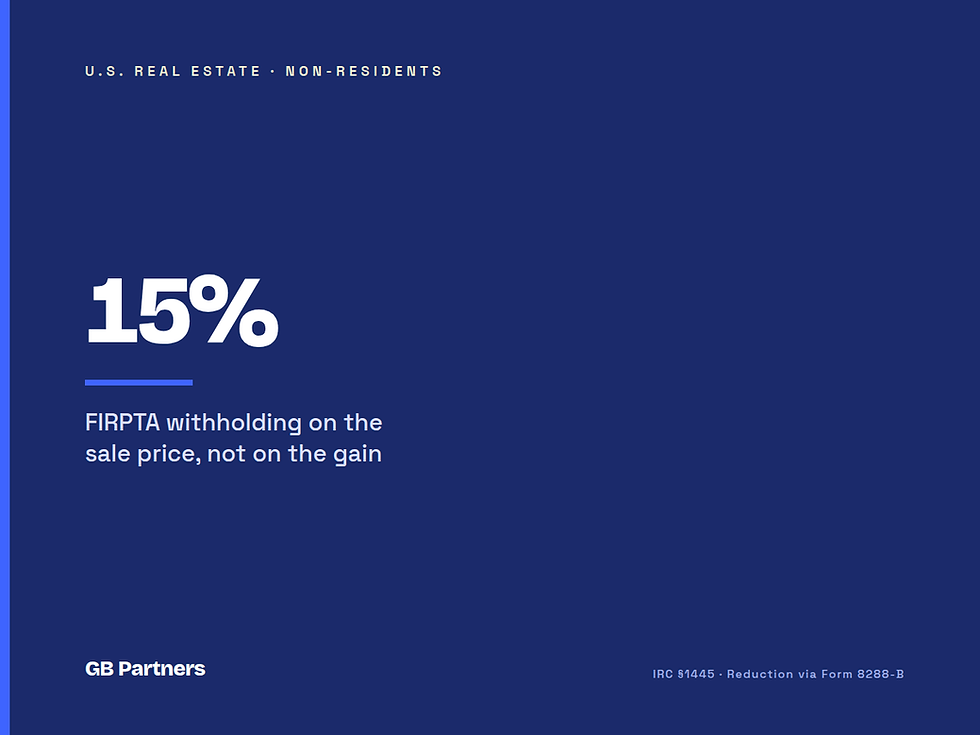
The sale. When a foreigner sells real estate in the United States, the buyer must withhold 15% of the sale price and send it to the tax authority. Of the price, not the gain. If you bought at 500,000 and sell at 520,000, the withholding is calculated on 520,000. It is recovered later, but meanwhile the money is not yours. A reduction can be requested, and it has to be requested before closing.
Rent. By default 30% of gross rent is withheld, without subtracting association fees, property tax, insurance, repairs or loan interest. There is an election that allows paying tax on the real profit with deductions, but it has to be made and the property manager has to be told. Those who do not make it often pay more tax than the year's profit.
The annual report. A foreign-owned LLC files an informational return every year, even with no income and no activity. The contribution used to form it already counts. The penalty for not filing starts at twenty-five thousand dollars and keeps running.
So
The LLC is not wrong and neither is the trust. Each one solves something. The LLC organizes the operation and separates liabilities. The trust avoids the court process and saves the family months.
The mistake is not using them. The mistake is believing that the 40% was solved with them, and finding out it was not on the day nothing can be done anymore.
Informational content only. It is not legal or tax advice and does not create an attorney-client relationship; each case depends on its own facts.
Responsible for this content: Camila Giraldo Bolívar, attorney admitted in New York and Colombia. GB Partners, Calle 5 A # 39-93, oficina 702, Medellín, Colombia. Phone and WhatsApp +57 305 234 6543. www.gbpartnersllc.com


Comments