
U.S. estate tax: the USD 60,000 exemption almost no one knows about
When a Colombian opens an investment account in the United States or buys an apartment in Miami, they almost always look at two things: returns and income tax. They rarely look at the third, which is the one that costs the most when it arrives.
The United States charges a federal tax on the transfer of wealth at death, the estate tax, and it charges it on assets located in its territory even if the owner never lived there, never held a residence visa and never filed a U.S. income tax return.
The two numbers
For 2026, a U.S. citizen or a person domiciled in the United States can transfer up to USD 15,000,000 without paying federal estate tax. Note that for this tax the test is domicile, which is not the same as tax residence for income tax purposes. This is the basic exclusion amount set by the law known as the One Big Beautiful Bill Act, signed on July 4, 2025, adjusted annually for inflation from then on.
For a non-resident who is not a U.S. citizen, the number is USD 60,000.
That is not a typo. The non-resident's unified credit is USD 13,000 under IRC §2102(b)(1), and that credit covers the tax on the first 60,000 dollars of taxable estate. Above that, the unified rate schedule applies, reaching 40%.
Same schedule, same rates, and an exemption two hundred and fifty times smaller.
What counts as U.S. property
The tax does not reach the non-resident's worldwide wealth. It reaches what has U.S. situs, and the situs rules are in IRC §2104 and §2105. That distinction is the technical part of the subject and also where almost all the planning happens.
Included, among others:
Real estate located in the United States.
Tangible property physically located there.
Shares of U.S. corporations, regardless of where the account that holds them is or where they were bought from.
Excluded, among others: the proceeds of life insurance on the non-resident's life, and bank deposits whose interest is not effectively connected with a U.S. trade or business.
That last point has exceptions worth not oversimplifying. Debt obligations of the United States, a state or the District of Columbia held by a non-resident are treated as property located in the country, and so are deposits with a domestic branch of a foreign corporation when that branch is engaged in commercial banking. "It's in the bank" does not answer the question on its own.
The point that surprises almost everyone is shares. A brokerage account with shares of U.S. companies is U.S.-situs property, even if the account is held by a Colombian who never set foot in the country. The location of the account does not change the situs of the asset inside it.
Why the problem shows up late
Because estate tax is not paid during life. It appears when the family tries to move the assets, and finds that the financial institution or the property title will not be released without the corresponding IRS certificate.
The return is filed on Form 706-NA. Until that happens, the assets are frozen. In practice, the family faces grief, a process in a language it often does not speak, and liquidity it cannot touch, all at the same time.
It is worth being precise, because the opposite is sometimes assumed. The United States has estate and gift tax treaties with a small group of countries, including Germany, Australia, Austria, Denmark, Finland, France, Greece, Ireland, Italy, Japan, Norway, the Netherlands, the United Kingdom, South Africa, Sweden and Switzerland. Colombia is not on that list, and there is no income tax treaty in force between the two countries either. There is no bilateral mechanism to reduce this exposure.
What this does mean
It does not mean that holding assets in the United States is a mistake. It means that how you hold them matters as much as the decision to invest.
The exposure depends on how the asset is titled, what type of asset it is, and whether there is a structure between the individual and the U.S.-situs property. Those three variables are decided before buying, not after, and changing them later usually has its own tax cost.
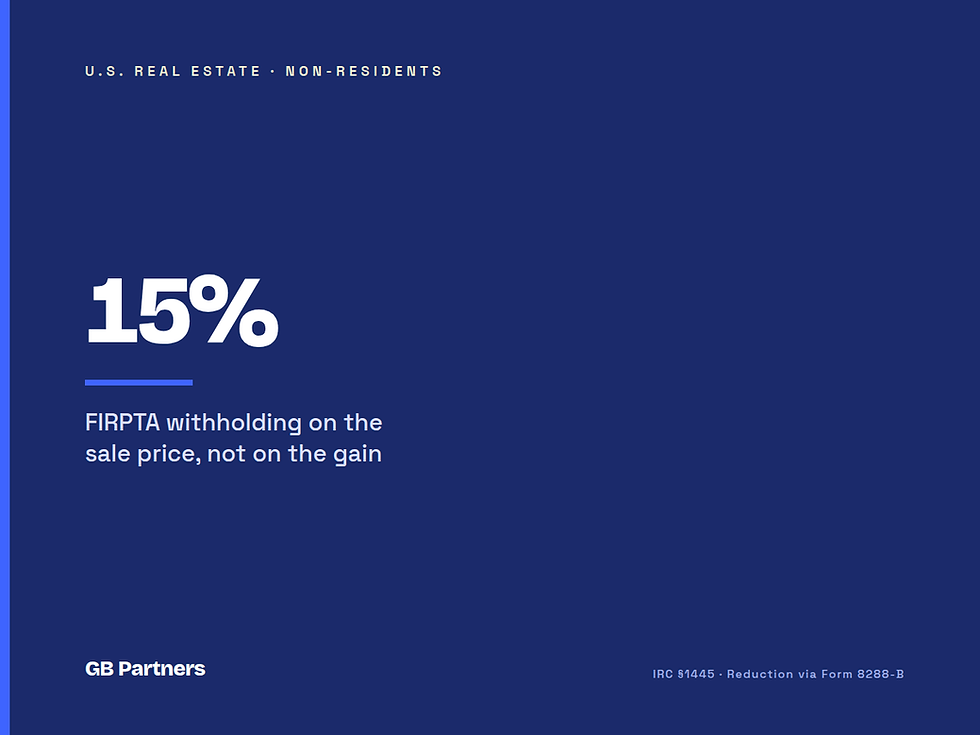
There is a common trap at the other end: using a foreign company to hold U.S. real estate can solve the estate problem and create an exit problem, because it triggers its own withholding rules when the property is sold. Solving one end and breaking the other is a common result when a structure is built looking at a single tax.
Three concrete questions
If you have assets in the United States, these are the three worth answering before anything else:
What part of those assets has U.S. situs under §2104, and by how much does it exceed USD 60,000?
In whose name is each asset today, and what would happen to it if the owner died this year?
If there is a structure in between, what does it cost to take the asset out when it is time to sell?
At GB Partners we review those three with concrete numbers, not in the abstract. Write to us and we will set up a first thirty-minute conversation.
Informational content only. It is not legal or tax advice and does not create an attorney-client relationship; each case depends on its own facts.
Responsible for this content: Camila Giraldo Bolívar, attorney admitted in New York and Colombia. GB Partners, Calle 5 A # 39-93, oficina 702, Medellín, Colombia. Phone and WhatsApp +57 305 234 6543. www.gbpartnersllc.com


Comments